
Can-One Berhad
SUMMARY OF KEY MATTERS DISCUSSED AT THE FIFTEENTH ANNUAL GENERAL MEETING (“15TH AGM”) OF CAN-ONE BERHAD (“CAN-ONE” OR “THE COMPANY”) HELD ON THURSDAY, 27 JUNE 2019
Pursuant to Paragraph 9.21(2)(b) of the Main Market Listing Requirements, a listed issuer must publish a summary of key matter matters discussed at the annual general meeting, as soon as practicable after the conclusion of the annual general meeting.
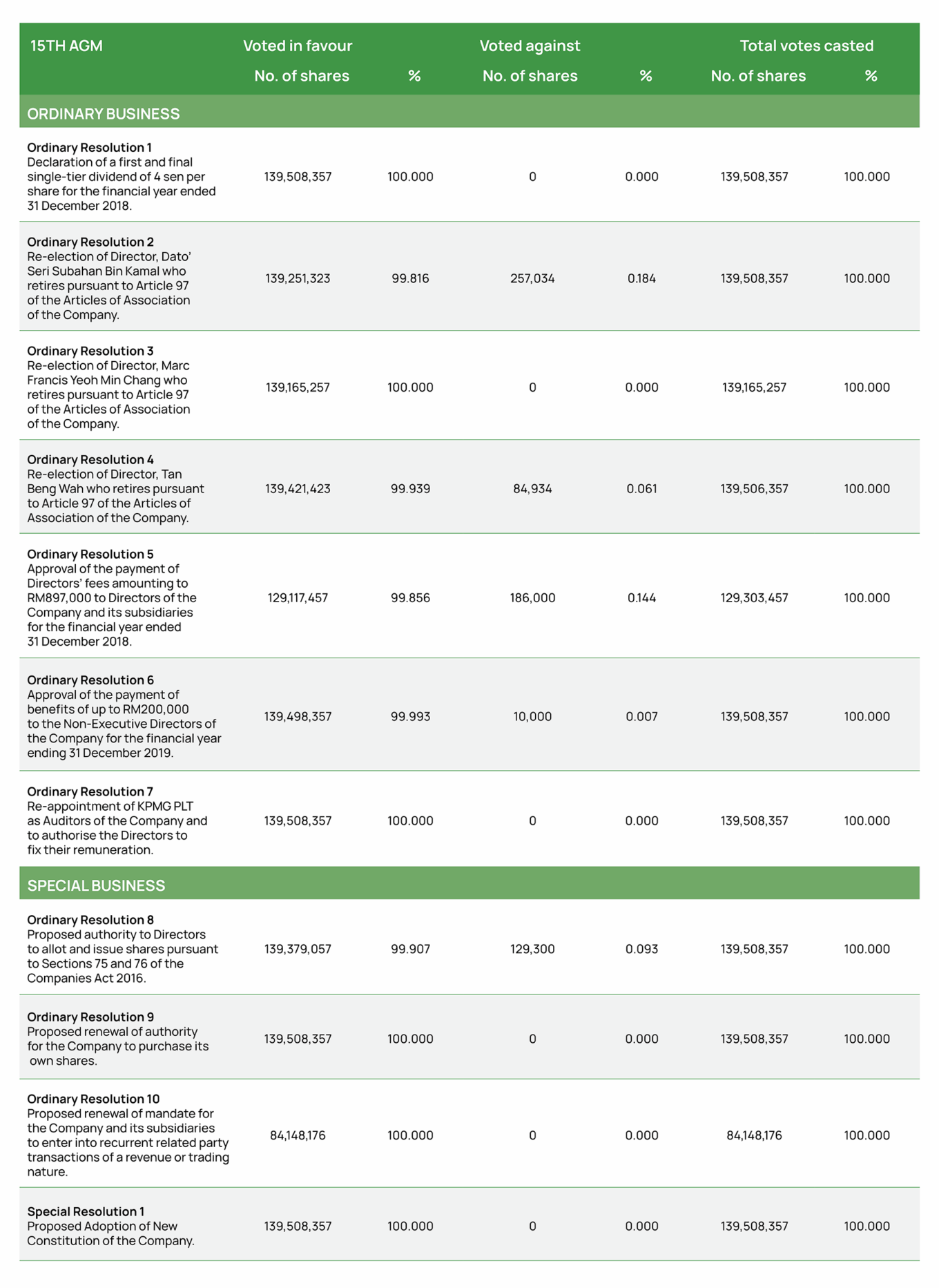
All resolutions that were tabled at the 15th AGM were duly approved by the Shareholders through poll voting. The Shareholders also received the Audited Financial Statements of the Company and of the Group, along with the Reports of the Directors and Auditors for the financial year ended 31 December 2018.
The results of the poll, which were announced by the Scrutineer, Asia Securities Sdn. Berhad, are as follows:
Can-One equity accounted the results of associate, Kian Joo Can Factory Berhad (“Kian Joo”). From the Consolidated Statement of Profit or Loss in Page 48, you will see that the main reason for the drop in Can-One Group’s profit in FYE 2018 was the decline in share of profit of Kian Joo from RM28.9 million in FYE 2017 to RM5.0 million in FYE 2018. Can-One Group by itself (excluding Kian Joo) posted a higher profit.
The main factor contributing to the reduction in Kian Joo Group’s profit from 2017 to 2018 was its expansion into Myanmar. Over the past 3 years, roughly more than RM800 million has been incurred for the 2 new plants in Myanmar and investment in these new plants have yet to bear fruit. The Myanmar plants which commenced operation early this year, are expected to contribute meaningfully only 3 to 5 years later.
On top of managing the cost of raw materials, we also need to manage the working capital for stocks. There is an internal committee to review the price of the main raw materials and if the price is good, we will lock in the price.
We are not into property development. Our properties are used for our own factories/usage.
An extraordinary general meeting will be convened to obtain members’ approval for the Proposed Disposal of F&B Nutrition. Therefore, all questions pertaining thereto will be addressed at the said extraordinary general meeting.
To put into perspective, Can-One will receive a cash consideration of RM800 million to RM1,000 million from the said disposal. Given that Kian Joo is now wholly-owned by Can-One, we will consolidate the earnings of Kian Joo moving forward. This will make up for the loss of contribution from F&B Nutrition.
For your information, the earnings before income tax, depreciation and amortisation (“EBITDA”) of Kian Joo Group for the FYE 2018 was RM143 million versus F&B Nutrition’s EBITDA of RM83 million. On top of that, there is also EBITDA of approximately RM20 million from Aik Joo Can Factory Sdn Berhad, our other wholly-owned subsidiary company.
The sales proceeds will likely be used to pare down Can-One’s borrowings.
The completion of the acquisition of Kian Joo has now put us in good state to consolidate both the businesses of Kian Joo and Can-One, and to continue with our reorganisation.
As stated in Can-One’s announcements and also the Offer Document for the mandatory general offer for Kian Joo shares (“MGO”), we will carry out a streamlining exercise, identify areas which will create enhanced scale and synergies, and convert them into value.
Kian Joo has committed and spent on capital expenditure (“CAPEX”) for expansion in order to build more business.
Yes, supply of cans is important to Can-One, hence during our negotiations with the purchaser, one of the conditions for the Proposed Disposal of F&B Nutrition is the execution of a long-term supply agreement to continue the supply of cans to F&B Nutrition.
We hope that the glory days of Kian Joo will come back again. We believe we are in a good position as we are now a regional player. Our target is to be competitive not only in Malaysia but also in other regions, hence the reason for the expansion.
On the raw material prices, Can-One has a team that review the prices of raw materials and lock the price if it is low enough. Additionally, there is mechanism in place to pass on the price increase in raw material to customers.
The ongoing trade war between United States of America and China poses certain benefits and opportunities but there are also some downsides. It provides us an opportunity to go overseas and take on competitors but at the same time, Malaysia has opened up for foreign companies to come in and compete with us.
Other than fluctuations in raw material prices, there is labour cost to manage. Large corporations such as Coke, Pepsi, Heineken, Nestle have introduced ‘e-tender’ where we have to submit our best and lowest bids. Post tender, they will press down our prices further.
Hence, we have to manage well, introduce more automation to reduce cost and increase capacity and continue to establish good relationship with our customers. We will continue to do the best we know how for Can-One Group.
Capital commitment of Can-One Group for FYE 2018 is set out in Note 25, Page 123.
Even though it is not a requirement in the Main Market Listing Requirements of Bursa Malaysia Securities Berhad, we take note of the suggestion.
KPMG are the external auditors for only the Malaysian companies.
The Board took note of the suggestion.
SUMMARY OF KEY MATTERS DISCUSSED AT THE FOURTEENTH ANNUAL GENERAL MEETING (“14TH AGM”) OF CAN-ONE BERHAD (“CAN-ONE” OR “THE COMPANY”) HELD ON THURSDAY, 26 APRIL 2018
Pursuant to Paragraph 9.21(2)(b) of the Main Market Listing Requirements, a listed issuer must publish a summary of key matter matters discussed at the annual general meeting, as soon as practicable after the conclusion of the annual general meeting.
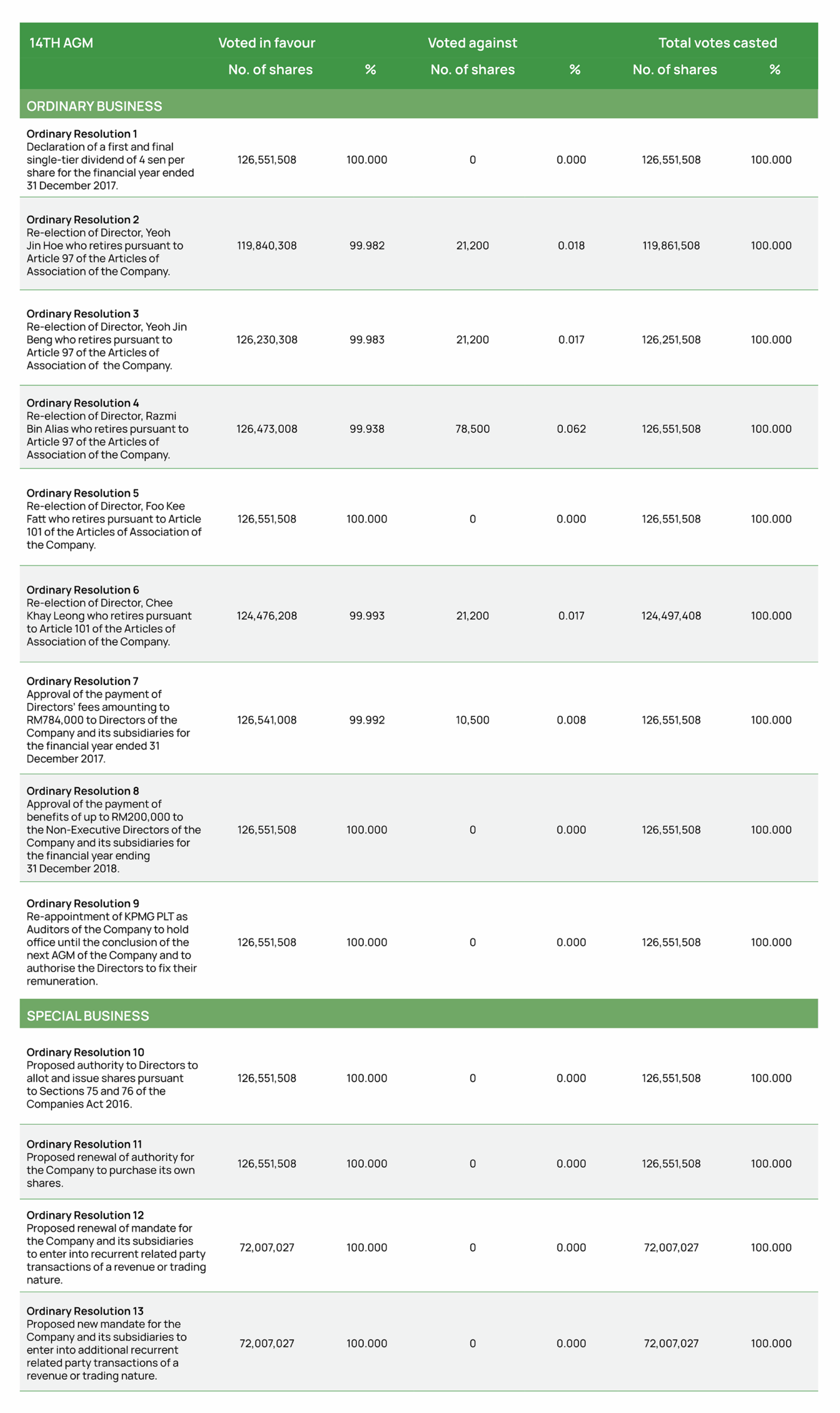
All ordinary resolutions that were tabled at the 14th AGM were duly approved by the Shareholders through poll voting. The Shareholders also received the Audited Financial Statements of the Company and of the Group, along with the Reports of the Directors and Auditors for the financial year ended 31 December 2017.
The results of the poll, which were announced by the Scrutineer, Quantegic Services Sdn Bhd, are as follows:
i. The Associate is in the midst of setting up a can manufacturing plant and a corrugated cartons manufacturing plant in Myanmar. Upon receiving the necessary investment permits in 2015, the Associate acquired two (2) pieces of industrial land in Thilawa Special Economic Zone and commenced construction work in 2017. The new plants are expected to commence operations in 2018.
ii. As a green field project, the Associate anticipates the new plants to contribute positive results within five (5) years from commencement of operations. The Associate intends to ride on the existing customer base in Malaysia and Vietnam to kick start its operations in Myanmar. Demand for tin cans, aluminium cans and corrugated carton boxes are anticipated to increase when the growth momentum in Myanmar gathers pace.
The main cause of the decrease in PBT of the Food Products division was mainly due to:
Barring any unforeseen circumstances, the current year growth should be back on track.
i. Please refer to the breakdown of the trade and other receivables on Page 81, Note 9.
The actual increase in trade debtors in FYE 2017 was 25.6% as compared to FYE 2016 and the balance of the increase was from Other Debtors. Other Debtors increased mainly due to amount receivable from the sale of a property, and prepayment for raw material and property, plant & equipment.
Nevertheless, the Management will continue to monitor the account receivables closely and ensure the credit control policy is effectively carried out.
ii. The impaired amount was for a wholly-owned subsidiary, Sanjung Nuri Sdn Bhd mainly due to negative shareholder’s funds. The impairment was made in FYE 2014 with RM60,000 reversal this year.
‘Other Operating Expenses’ comprised realised and unrealised foreign exchange loss, bank charges and commission, property, plant & equipment written off and miscellaneous expenses.
‘Other Operating Income’ comprised gain on disposal of property, plant & equipment, compensation from customer, sales of scrap, insurance claims, rental income and other income.
The foreign exchange losses were mainly due to strengthening of USD over RM and the inability to hedge its USD open position when Bank Negara Malaysia changed its policy to only allow settlement of sales/purchases from local companies which are denominated in foreign currencies, to be made in RM.
The Management has managed to change all its purchases and sales from local companies which are denominated in foreign currencies into RM to mitigate this exposure.
We take note of the above and have modified our CG Report accordingly.
We would like to stress that none of the members in the current Board has exceeded the 9-year tenure.
We are of the view that the selection of a candidate for the Board should be dependent on the candidate’s skills, expertise, experience, integrity, character, commitment and other qualities in meeting the requirements of the Company, regardless of gender.
Female representation is to be considered when suitable candidates are identified underpinned by the overriding primary aim of selecting the best candidate to support the Group’s objectives.
We took note of your comments but we would like to stress that we hold our AGMs in venue which is easily accessible and at reasonable hours. Shareholders who do not intend to attend the meeting are encouraged to vote via their proxies. Nevertheless, the Company will explore the use of technology to facilitate voting in absentia and/or remote shareholders’ participation at general meetings after taking into consideration, the accuracy and stability of such technologies, applicable laws and regulations, and resources required in relation to the benefits.
The reduction was due to enlargement of the denominator attributable to the enlarged capital base. The Group reported a lower profit in FYE 2017 due to the surge in the prices of raw material, sugar and also foreign currency exchange (“FOREX“) losses.
Presently, the Company does not a formal or written guideline on ROE. An acceptable level would be 10%. 2017 was an exceptional year for the Group for the reasons mentioned earlier. The price of the raw material, tin plate had also increased.
Hopefully, with the strengthening of RM against USD in 2018 and the drop in prices of sugar and tin plate, the Group can achieve a better result and correspondingly, a higher ROE.
We appreciate your views and take cognisance of your suggestions.
Can-One’s investment in associate was at a cost of RM242 million. For equity accounting, the Group’s share of profit from KJCF is annually taken in. Hence, the investment in associate has ballooned to RM500 over million. It will continue to increase unless the associate make losses or Can-One disposes off certain portion of its equity in the associate.
KJCF is the largest tin can and aluminium can manufacturer in Malaysia controlling about 60% of the local market. It is also in the midst of developing certain plastic packing material. KJCF is indeed very important to us.
We take note of your suggestion on the dividend-in-specie
Until December 2017, Can-One had cash pledged to bank. However, currently there is no more pledge.
We take note of your suggestion but we are conserving cash for working capital, paring down borrowings and seeking opportunities in the market. A bit of sacrifice now by shareholders of the Company will give better returns in the future.
We take note of your comment.
A lot of the trade debtors settled their debts owing to the Group at the end of December 2017 which explained for the huge cash reserve in the profit and loss account. However, we cannot use all of it to pare down borrowing as a portion of the cash reserve is needed for working capital.
We will nevertheless attempt to minimise borrowings as much as possible in order to reduce interest expenses.
With the approval in hand, the Company can purchase its own shares at any time without having to convene a general meeting for that purpose. Hence, the recurring resolution for Share Buy-Back each year.
SUMMARY OF KEY MATTERS DISCUSSED AT THE THIRTEENTH ANNUAL GENERAL MEETING (“13TH AGM”) OF CAN-ONE BERHAD (“CAN-ONE” OR “THE COMPANY”) HELD ON THURSDAY, 27 APRIL 2017
Pursuant to Paragraph 9.21(2)(b) of the Main Market Listing Requirements, a listed issuer must publish a summary of key matter matters discussed at the annual general meeting, as soon as practicable after the conclusion of the annual general meeting.
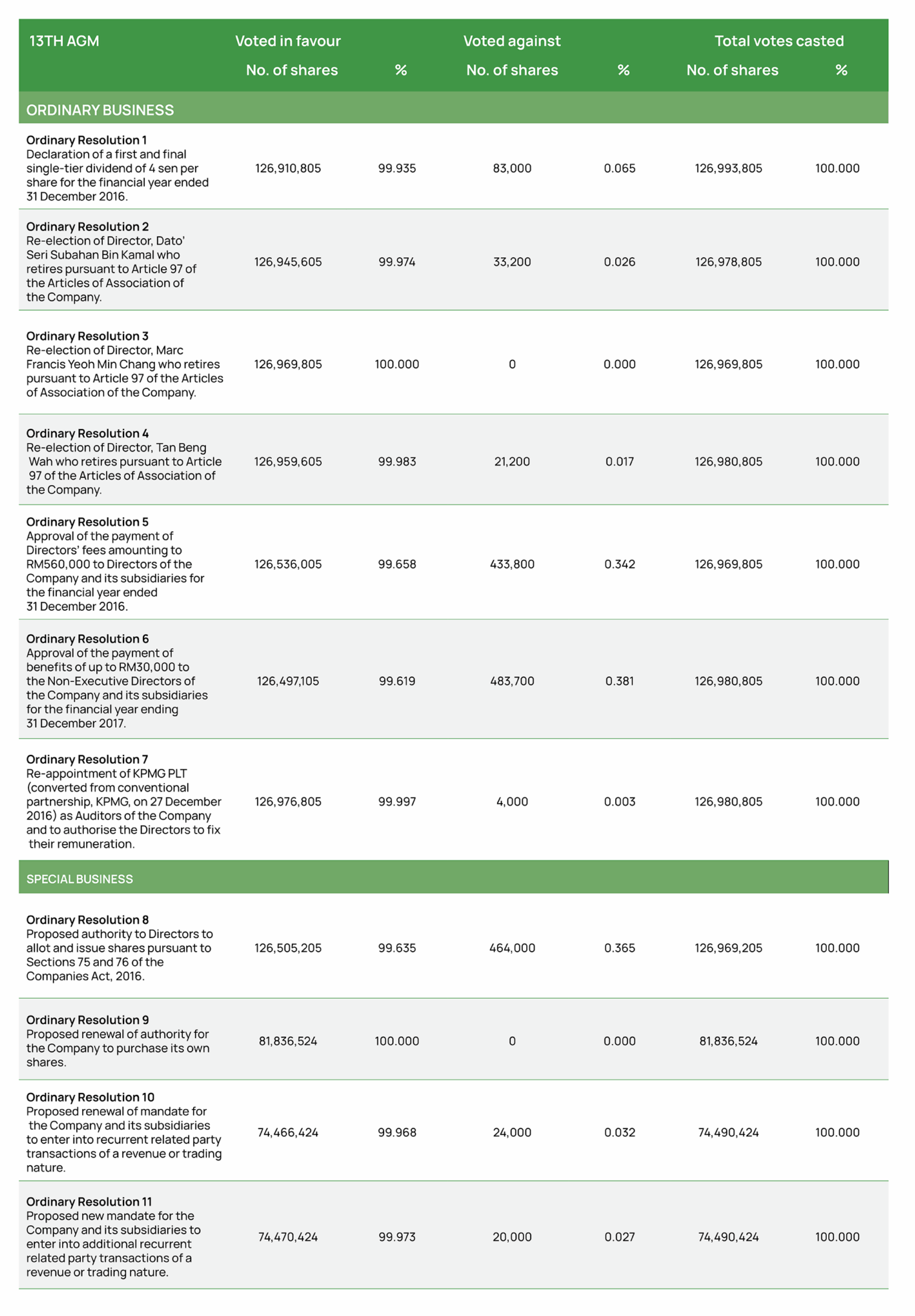
All ordinary resolutions that were tabled at the 13th AGM were duly approved by the Shareholders through poll voting. The Shareholders also received the Audited Financial Statements of the Company and of the Group, along with the Reports of the Directors and Auditors for the financial year ended 31 December 2016.
The results of the poll, which were announced by the Scrutineer, Asia Securities Sdn Bhd, are as follows:
(a) The geographical segment of revenue in page 92 refers to the geographical location of the customers rather than destination of the goods. The drop in demand from a trader in Singapore was the main contributing factor for the decline in revenue for FYE 2016. However, this was offset by increased sales to other customers.
The Company is optimistic of the Asia market (excluding Malaysia) and anticipates a higher sales from this segment.
(b) Data analysis of the Group’s vis-à-vis its competitors in Asia is not available. The Group will continue to grow its performance OEM business by providing good quality products and services to customers at competitive pricing. The Group hopes to achieve double digit growth in revenue going forward.
The Group will look into improving the productivity and containing cost in 2017. Another area is automation such as robotic arms and purchase of new high speed machineries.
In order to achieve sustainable growth, the Group would need to increase capacity every 3 to 5 years depending the demand and the economic conditions. The last plant expansion was in 2015 and the current capacity utilisation of the dairy plant is approximately 70%.
The planned capital expenditure over the next 3 to 5 years would be approximately RM150 million to RM200 million.
(a) As at todate, the status is as follows:
i. RM252,000 – Already collected;
ii. RM289,000 – Provided for as legal and doubtful debt; and
iii. RM485,000 – Provided for as legal bad debts.
Legal action has been taken to recover the doubtful debts and bad debts. Meantime, the management is still engaging and negotiating with the delinquent debtors to settle their debts.
(b) The management is aware of the credit risk associated with trade receivables and has taken the following measures to mitigate the risks:
i. Enhance credit evaluation process i.e. those trade accounts with purchases of RM500,000 and above would require management’s review;
ii. Establish terms of sales, and subject credit limit and amount to be approved by the Executive Directors;
iii. Review trade receivables on a monthly basis and weekly review of the collections; and
iv. Review turnover days of trade debtors by limiting delivery of total orders at 70%.
In spite of the higher sales volume in FYE 2016, trade debts had decreased from RM291 million in FYE 2015 to RM261 million. Turnover days have also improved from 121 days to 103 days in FYE 2016. Nevertheless, due to the current stiff economic condition, the Company will be instituting further measures to mitigate the credit risk.
Out of the RM779,000 impaired assets, RM656,000 of such assets have been sold this year for RM630,000. The management is actively looking for buyers for the remaining impaired machines.
As at current date, there is no further impairment. However, the management is required to identify and provide for impairment of fixed assets on an ongoing basis in compliance with the Malaysian Financial Reporting Standards (“MFRS”).
The contract with a former Executive Director who has been re-designated as a non-executive director and oversees associate company, Kian Joo Can Factory Berhad, is still subsisting.
Other than the benefits of up to RM30,000, no other benefits will be payable to Non-Executive Directors for FYE 2017.
If combined with Kian Joo group of companies, the Group currently commands 70% to 80% of the tin cans and aluminium cans market in Malaysia. Hence, the Group has to look to external markets. In the milk products segment, the Group’s capacity is number 1, with installed capacity of 250,000 tonnes per year, which is slightly bigger than F&N.
The RM150 million will be spent to create more stock keeping unit (SKU) i.e. acquiring more manufacturing line for the dairy division under F & B Nutrition Sdn. Bhd. (“F&B”) to cater for the increase in export markets. F&B is solely an OEM company and do not have any house brands to compete with customers.
Can-One Berhad